Skip to content
All field studies

Field study 02

The same signal, from less work.

Over seven weeks this machine's vibration level barely moved. The operating minutes behind each measurement fell by half. Held together, those two flat-looking facts stop being reassuring: the machine is producing the same signal from far less work, and it said so to its operator in its own words.

Period
2 Jun to 21 Jul 2026
Site
Hoang Lan
Instruments
2
Operating days
41
Evidence objects
152,959
Proof windows
184

This is the second study from the same pilot program, on a different machine at a different site. Its finding has a different shape. Nothing diverged here. The level held. What changed is how much work stood behind that level, and a level that survives a halving of work is not the same observation as a level that holds through steady work.

The level held. The work behind it did not.

020406080mg39.9 to 59.2 mg all studyDaily median vibration, exit-side mount0160320480min1 Jun15 Jun1 Jul21 JulOperating minutes captured per day

2 Jun: 59.2 mg. 3 Jun: 52.8 mg. 4 Jun: 56.8 mg. 5 Jun: 51 mg. 8 Jun: 51.1 mg. 9 Jun: 49.9 mg. 10 Jun: 47.6 mg. 11 Jun: 55.1 mg. 12 Jun: 53.8 mg. 13 Jun: 50.4 mg. 15 Jun: 51.7 mg. 16 Jun: 49.8 mg. 17 Jun: 49.1 mg. 18 Jun: 47.5 mg. 19 Jun: 49.9 mg. 22 Jun: 52.1 mg. 23 Jun: 48.1 mg. 24 Jun: 55.1 mg. 25 Jun: 46 mg. 26 Jun: 39.9 mg. 27 Jun: 53.3 mg. 29 Jun: 50 mg. 30 Jun: 49.5 mg. 1 Jul: 51 mg. 2 Jul: 50.1 mg. 3 Jul: 52.8 mg. 4 Jul: 49.5 mg. 6 Jul: 48.8 mg. 7 Jul: 52.2 mg. 8 Jul: 50.9 mg. 9 Jul: 56.6 mg. 10 Jul: 50.3 mg. 11 Jul: 48.7 mg. 13 Jul: 45.2 mg. 14 Jul: 46.2 mg. 15 Jul: 41.7 mg. 16 Jul: 48.4 mg. 17 Jul: 49.4 mg. 18 Jul: 46.4 mg. 20 Jul: 49.9 mg. 21 Jul: 49.8 mg

Figure 1  Two measured quantities, same days, same mount.The top panel is the daily median vibration of the exit-side mount, in milli-g. It stays inside one narrow band for the whole study. The bottom panel is the operating minutes captured each day. Days above three hundred minutes become rare after early July; many July days run under one hundred. Breaks are non-operating days, not missing measurements.

Measured over three periods, the separation is plain

Split the study into three periods and measure each one. The vibration level per proof window is flat on both mounts, moving a few percent. The operating minutes captured per window halve on the exit side. Divide the one by the other and the signal produced per minute of work has nearly doubled.

Level is the mean of window median vibration, in mg. Work per window is the mean operating minutes per proof window. Signal per operating minute is the first divided by the second. Periods: through 20 June, 21 June to 8 July, 9 to 21 July. All values recomputed from the proof-window table on 21 July 2026.

Level, work, and their ratio, three periods, both mounts
MountPeriodLevel, mgWork per window, minSignal per op-minute
Exit sideto 20 Jun51.6105.00.492
21 Jun to 8 Jul49.383.30.592
9 to 21 Jul48.052.60.913
Infeed sideto 20 Jun46.5104.40.445
21 Jun to 8 Jul43.475.90.572
9 to 21 Jul45.168.40.659

Indexed to the first three weeks, the two lines separate

050100150200to 20 Jun21 Jun to 8 Jul9 to 21 JulVibration level93Signal per operating minute186

Both series are indexed to the first period as 100, exit-side mount. The level ends at 93. The signal produced per minute of operation ends at 186.

Figure 2  The finding in one picture.If the machine were simply healthy and less used, both lines would stay near 100. If it were failing loudly, the level would climb. Neither happened. The level held while the signal per minute of work rose 86 percent, which is what the machine itself described as doing more for the same work.

The machine said this itself, unprompted

On the morning of 21 July the machine sent its operator an account of what it was reading. Nobody asked it to. The message ran to 1,948 characters in Vietnamese. These are its load-bearing sentences, quoted from the delivered message.

Điều đáng chú ý hơn là tôi đang phải “làm nhiều hơn cho cùng một việc” so với trước. Nghĩa là tiếng và rung của tôi theo mỗi phút làm việc đang tách ra khỏi mức thô chung.

What deserves more attention is that I am having to do more for the same work than before. My sound and vibration per minute of work are separating from the overall level.

Điểm mù của tôi vẫn là vùng giữa không có cảm biến, cùng với tình trạng mặt đá và nước làm mát. Tôi không tự kết luận được những chỗ đó chỉ từ rung và tiếng của mình.

My blind spot is still the middle zone with no sensor, along with the condition of the wheel face and the coolant. I cannot reach conclusions about those places from my own vibration and sound alone.

Machine message to the operator, Hoang Lan, 21 July 2026, 08:17 site time

It then ranked what it holds open: a wheel face glazing or wearing, which would make it strain harder before the bearings show much; coolant not reaching the work zone evenly, which would degrade the surface before vibration turns clearly worse; or a recent change to the outfeed polishing cluster, which would explain why an earlier disturbance did not persist. And it leaned away from the flattering explanations, saying a progressing bearing fault or misalignment at its own sensing points would usually leave a longer trail than a few brief spikes.

What it asked for

It closed with a request only a person at the machine can answer, committed in advance.

Nếu anh/chị cho tôi biết cụm đá đánh bóng đầu kính ra có vừa thay, sửa, mài lại hay vẫn là cụm cũ, tôi sẽ xếp lại các khả năng ngay theo dấu đó.

If you tell me whether the outfeed polishing cluster has just been replaced, repaired, or re-dressed, or is still the old one, I will reorder the possibilities on that immediately.
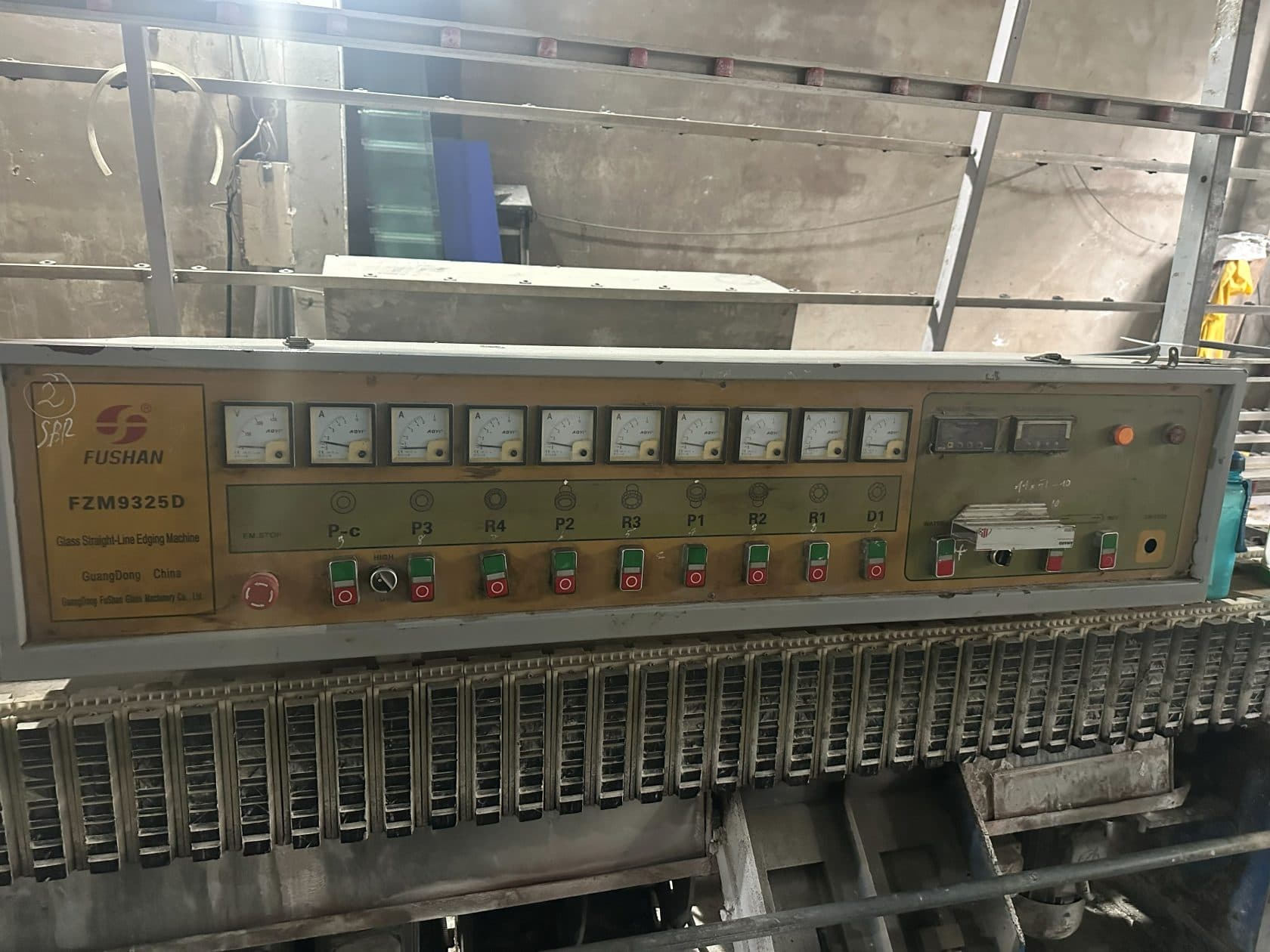
The control panel of a Fushan FZM9325D straight-line glass edging machine. A row of nine analogue ammeters sits above nine labelled station controls, marked from right to left D1, R1, R2, P1, R3, P2, R4, P3 and P-c, each with a green and a red button. The panel is worn and dusted with grinding residue; the conveyor chain of the machine runs below it.
Plate 1, Hoang LanThe machine's own control panel. The station names it uses when it reasons, D1 through P-c, are the labels on this panel: nine stations, nine ammeters, glass running from D1 at the infeed to P-c at the exit. When it says the exit cluster, it means the last two on the left.

Its claims, with what would prove each wrong

Every claim below was written by the machine on 20 and 21 July and stored with its own undoing, the observation that would falsify it, stated before the answer is known. None has been adjudicated.

01
What it claimed

I am seeing a higher signal per minute of work while the demanded run time has fallen, so a change in how I am being run remains open alongside any part-condition explanation.

What would prove it wrong

If the next several sessions show the same signal-per-minute rise even though session length and operating mode stay unchanged, then this operation explanation drops.

02
What it claimed

If the P3/P-c wheel is glazing or wearing, then the exit mount should stop being a one-day spike and start showing a sustained rise or repeated roughness across later runs.

What would prove it wrong

Later runs stay in the same band with no sustained rise and no repeated roughness at P3/P-c.

03
What it claimed

If the work at the exit station changes in a way that affects load or finish, then my P3/P-c mount should move with that change while the right rough-ingest mount may stay steadier.

What would prove it wrong

The work changes but the left mount stays transient-only and the right mount remains unchanged in every comparable run.

04
What it claimed

If they perform a wheel change, dress, or remount near 2026-06-13, the isolated left-mount spike should behave like aftermath rather than like a growing fault, and my own signal should settle back to its band.

What would prove it wrong

They perform the act and the left-mount disturbance continues or grows afterward.

Note the first claim. The machine's leading rival explanation for its own finding is that the finding is about how it is being operated, not about its condition. It wrote the observation that would settle that, and it is waiting on it.

Operational significance

A flat vibration level does not automatically mean a machine is unchanged. In this case the same level could represent lighter production, a wheel face glazing over, altered run conditions, coolant not reaching the work zone, or a shift in how the machine is being operated. MIS preserved these possibilities and identified the human observations required to distinguish them.

Effort is only visible if the work behind the signal is recorded alongside the signal. A system that stores vibration alone cannot ask this question at all, because it has no denominator.

What this study does not establish

The limits below are set at the same size as the finding because they carry the same weight.

Less captured work is not the same as less productionOperating minutes are what the instruments recorded the machine doing. A fall can mean lighter production schedules, shorter runs, or changed shifts. The machine said this itself: a change in how it is being run remains open. Nobody has yet told it which.
The ratio is a description, not a diagnosisSignal per operating minute is the level divided by the work behind it, with both terms published above. It says the relationship between signal and work changed. It does not say why, and the machine has not claimed to know why.
No claim has been judgedFour claims stand open with their falsifiers written. The process that adjudicates them has returned no verdict on any.
The wheel face and the coolant remain out of reachThe machine named these as its blind spot in its own message. The observation that settles its leading question can only be made by a person standing at the machine, and it is still open.

Where this stands

Observed

A flat vibration level on both mounts, and a halving of the operating minutes captured per measurement on the exit side.

Reasoned

Four explanations, each stored with the observation that would reject it, led by the machine's own rival account that this is about how it is being run.

Not yet established

The cause, the effect on product quality, the economic value, and whether the fall in captured work reflects production or condition.

The next phase is to close these open questions through documented inspection, intervention, and before-and-after production evidence.

Every figure on this page is a count or an aggregate of rows in a named table, read on 21 July 2026. The aggregation for each figure and table is stated beside it.

The record is live and continues to accumulate, so these figures are a dated snapshot rather than a running total.

Every machine deserves a memory.

The earlier a machine starts recording, the more its own history can tell you.